
Client management for small business India often looks something like this: a few numbers saved on WhatsApp, an Excel sheet with half the columns outdated, and a mental note to follow up next week that quietly gets forgotten.
The real cost of this kind of setup isn’t obvious day to day. It shows up later: a client you forgot to follow up with goes to a competitor, an invoice sits unpaid because nobody was tracking it, or two team members give a client two different answers about the same project. None of these are big failures on their own, but together they slow growth and quietly damage trust.
The good news is that fixing this doesn’t require an expensive enterprise system or a complicated process overhaul. It starts with a few habits and a bit of structure. Here’s how to build that.
Here’s what a well-organized client management system looks like end-to-end — from first contact to long-term retention:
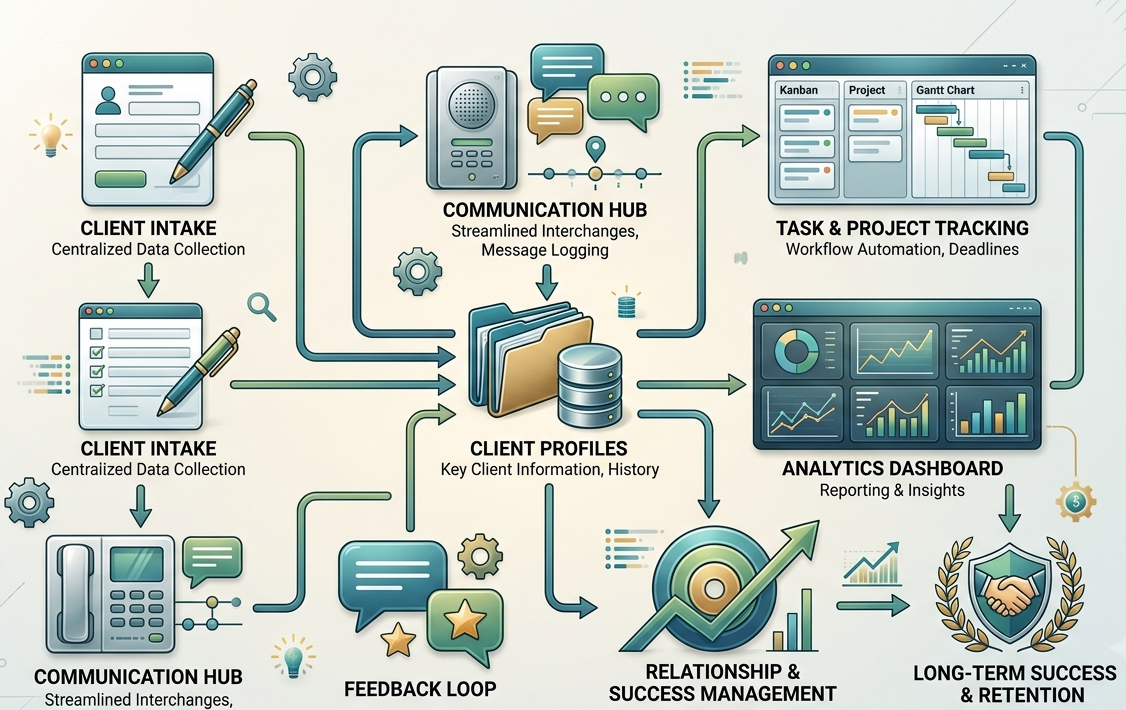
Centralize Client Information for Better Client Management
The biggest source of client-management chaos is simple: information is scattered. A client’s phone number is in one person’s phone, their email thread is in another inbox, their payment history is in an accountant’s spreadsheet, and their project notes are in someone’s notebook. When information lives in five different places, it effectively lives nowhere — nobody can pull up the full picture of a client in seconds.
A better setup keeps everything about a client in a single record: their contact details, a history of conversations, what project or service they’re currently engaged in, and their billing status. It doesn’t need to be fancy at first — even a well-organized shared spreadsheet is a step up from scattered notes — but the goal should always be one source of truth per client, accessible to everyone who needs it.
Standardize Your Client Onboarding
Every new client relationship starts the same way: introductions, expectation-setting, and information gathering. Yet many small businesses treat each onboarding as a one-off, reinventing the process each time and inevitably forgetting a step.
A standard onboarding checklist fixes this. At minimum, it should cover a welcome message that sets the tone, a clear list of documents or details you need from the client, and an explicit conversation about timelines and how communication will happen going forward — which channel, how often, and who the client’s main point of contact is. Writing this down once means every new client gets the same professional experience, regardless of who on your team is handling the onboarding.
Set Up Follow-Up Reminders — Don’t Rely on Memory
Most lost business isn’t lost because a client said no. It’s lost because nobody followed up. A quote sent and forgotten, a renewal date that quietly passed, a client who asked a question that never got answered — these are the quiet leaks in a growing business.
The fix starts simple: calendar reminders for every commitment you make to a client, no exceptions. If you say “I’ll follow up Friday,” that needs to exist somewhere outside your memory. As your client list grows, this becomes harder to manage manually, which is usually the point where businesses start looking at tools that can automate follow-up reminders based on client activity rather than relying on someone remembering to check a calendar.
Track Projects and Client Status Together
In client management for small business India, it’s common for businesses to track “what we’re working on” separately from “who it’s for.” — a project management tool in one place, client details in another. The problem is that client relationships and project work are deeply connected. A client asking “where are we on this?” needs an answer that reflects both the project status and the full context of their relationship with you.
When project and client information live together, anyone on your team can answer a status question accurately, without needing to ping three people first. This single change eliminates a huge amount of the internal back-and-forth that slows client-facing teams down.
Keep Invoicing and Payments Organized
Good client management for small business India also means keeping invoicing simple — GST compliance, tracking paid versus pending, and the awkward “did they pay yet?” conversations between sales and accounts — GST compliance, tracking which invoices are paid versus pending, and the awkward “did they pay yet?” conversations between sales and accounts. When invoicing is disconnected from client and project records, these questions take far longer to answer than they should.
Keeping invoices linked to the relevant client and project means you always know, at a glance, what’s been billed, what’s outstanding, and what’s due next. It also makes it much easier to have a clean, professional payment conversation with a client instead of an uncertain one.
Set Clear SLAs and Communication Expectations
In client management for small business India, clients notice inconsistency fast. If one team member promises a same-day response and another takes three days to reply, it reflects on your business as a whole — even if both people are doing their best. Setting clear internal expectations for response times, escalation paths, and who “owns” each client relationship prevents this kind of mixed messaging.
This doesn’t need to be a formal document. Even an informal internal standard — “we respond within 24 hours, and X person is the primary contact for Y client” — goes a long way toward client experience feeling consistent and professional.
When to Move Beyond Spreadsheets
Spreadsheets and shared notebooks are a perfectly reasonable starting point. But there are clear signs a business has outgrown them: follow-ups are consistently missed, team members give clients conflicting information, there’s no easy way to see a client’s full history at a glance, or onboarding a new client means manually copying data from an old proposal every single time.
None of these are personal failures — they’re simply what happens when the volume of clients and information outgrows a manual system. At that point, the goal isn’t to work harder at managing spreadsheets; it’s to put a system in place that does the tracking and reminding for you.

The Bottom Line On Client Management for Small Business India
Client management for small business India isn’t about effort or good intentions— most business owners already have plenty of both. It’s about having a system that doesn’t depend on memory, doesn’t scatter information across five places, and doesn’t fall apart when your team or client list grows.
Start with the basics: one place for client information, a standard onboarding process, and reliable follow-up habits. From there, it becomes much easier to see exactly where a dedicated system can save your team the most time — which is exactly what we’ll cover next in Top CRM Features Every Business Needs in 2026.